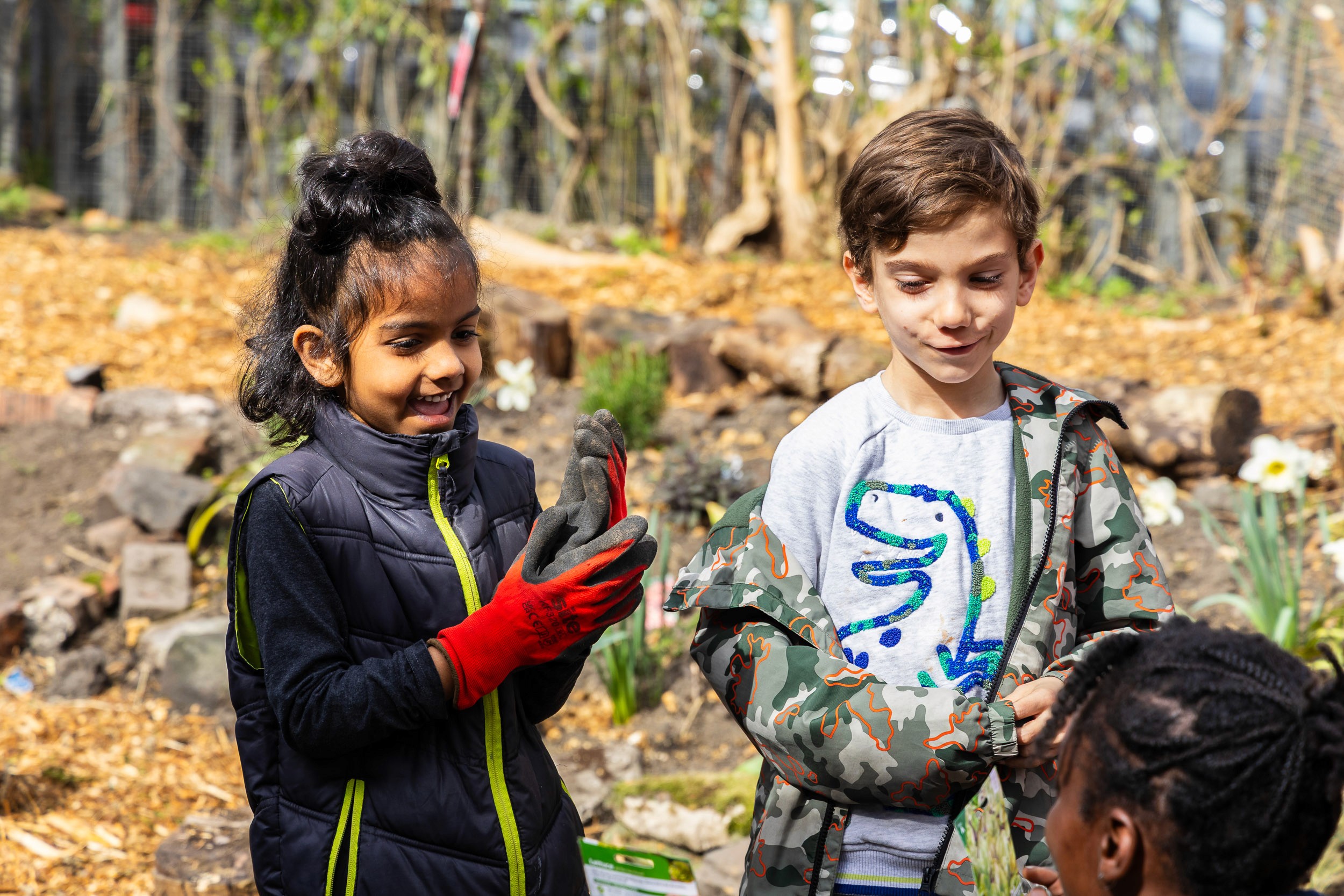
Since January 2024, arts organisation Yorkshire Contemporary has been working with volunteers, including families, students, artists, and the Rowland Road Working Men’s Club membership, to transform an unused patch of land into a playground and community space. Referencing the Adventure Playground Movement and Play Bradford’s Big Swing Adventure Playground in particular, the Play Patch builds on the philosophy of ‘playwork’, which emphasises child-led, non-prescriptive play.
Differing from a traditional playground installation, the Play Patch includes:
Semi-permanent and self-built structures
A mix of fixed play equipment and loose parts
Managed risk rather than risk elimination.
Designed and built in a collaborative process over several months, the playground launched last March, and now, each Saturday, the space is open freely to children and families, facilitated by volunteers. Activities include building and den-making; gardening and growing; arts and crafts, as well as spaces to sit, talk, and connect. The space is designed to continue adapting and evolving, shaped by the people who use it.
A community development project
Driven by the lack of safe, accessible places nearby where children could play freely, and wanting to bring back something that felt increasingly absent – time spent outdoors, exploring, building confidence, and being part of a community – local parents Jade and James looked for a solution. With the help of Ed Carlisle, a local Green Party councillor, they identified a possible site for transformation: a large, derelict patch of land behind Rowland Road Working Men’s Club.
Yorkshire Contemporary, with their experience in play-based approaches to contemporary art, was brought on board to help steer the project. The Play Patch has been a curatorial project for the arts organisation, exploring how creating space for children’s play can mobilise a community. The process is underpinned by an approach that “values participatory and accessible forms of co-creation, with an understanding of the often-invisible labour required to make meaningful community-led design possible”, says Caitlin McHugh, Assistant Curator at Yorkshire Contemporary.
The project has seen nearly 1,300 participants (over half of whom were children) contribute to its development, from clearing the site to designing and constructing the playground. Local residents were canvassed about the proposed playpark, and concerns were taken into account as the project progressed. Initially, 73% of residents supported the idea, and the team listened to concerns of those who were unsure – mostly regarding noise and privacy for neighbouring houses – and adapted the project accordingly, gradually building trust and support.
Students from the local universities also got involved. One student on placement at the Play Patch was Poppy, studying BA Landscape Architecture at Leeds Beckett, who felt that the project highlighted “just how integral community involvement is to the longevity of projects and stewardship, and will continue to influence how I design. [...] I have learnt that play is more than a structured playground; rather, it is interpretive, multigenerational, and evolving.”
The role of social clubs
Members of the Rowland Road Working Men’s Club are integral to the project, volunteering their time for gardening, building, and maintenance; managing the volunteer calendar and organisation of resources; and promoting the Play Patch, both through social media and through their strong community networks.
A one-year birthday celebration of the Play Patch took place at the end of March, utilising the club’s car park as well as the play space, to draw attention to the ongoing partnership and collaboration.
Caitlin said, “We are inviting neighbours with and without children, hopefully highlighting the club as a friendly, warm space for all community members.”
The collaboration poses some interesting questions and suggests more opportunities of this kind. How can underused assets, like the land behind the club, be revitalised for public benefit? And can social clubs become ‘multi-generational commons’?
Future governance
During the design and build process, training sessions were undertaken in order to equip volunteers with the necessary skills, including safeguarding, first aid, and learning how to use power tools. The Yorkshire Contemporary team found that indoor, classroom-style sessions were less effective than when volunteers were engaged as equitable contributors and began facilitating sessions independently. This shift to learning through doing and sharing skills in practice helped to strengthen trust and a sense of democratic credibility, and by November 2025, the arts organisation has been able to step back into a supportive role and allow the volunteers to take more responsibility.
This shift will continue; the long-term aim is sustainability through shared governance, but this requires ongoing scaffolding, training, and clarity. Alongside infrastructure upgrades (kitchen, accessibility, external tap, and electrics), the project has prompted discussions about a long-term model for the Play Patch, such as:
Could the Working Men’s Club run the playground?
Should the project become an independent organisation?
Can volunteer governance sustain risk-aware play provision?
Would paid playworkers strengthen resilience or take away from the community-run ethos?
Reflecting on the project, Alexandra Long, course director for BA (Hons) Childhood Development and Playwork at Leeds Beckett University's School of Health, said, “The project has brought together an unlikely cross-section of the community, unified in the aim of meeting the unmet play needs of local children.”
By opening the doors of the local working men’s club to the community, the project “offers a progressive solution to sustaining community assets", and, as a result, “neighbourliness and social connection is beginning to flourish, around a place for children to play.”
To find out more about Rowland Road Play Patch, visit the Yorkshire Contemporary website or contact caitlin.mchugh@yorkshirecontemporary.org